


Article
The Autonomous Storage Era: Navigating the Capabilities of the IBM FlashCore Module 5
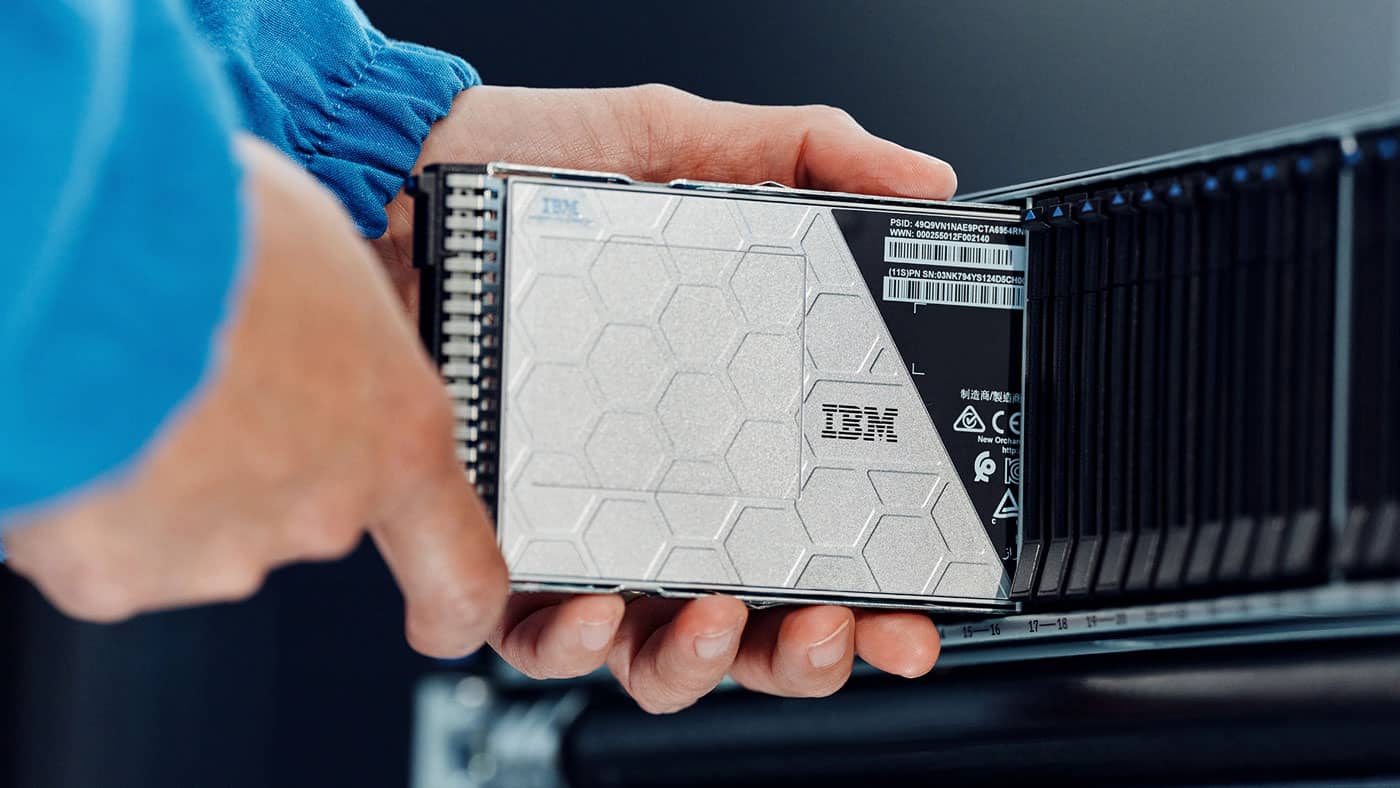
The pressure to maintain ‘always-on’ availability while simultaneously defending against increasingly sophisticated cyber threats has never been more acute. Storage is no longer just a passive repository for bits and bytes; it has become the front line of the digital estate. With the launch of the IBM FlashSystem 5600, 7600, and 9600, IBM has introduced the fifth generation of its bespoke computational storage: the FlashCore Module 5 (FCM5).
This latest iteration marks a fundamental shift from reactive monitoring to autonomous resilience. By embedding agentic AI and advanced telemetry directly into the hardware, the FCM5 provides a level of proactive defence and performance optimisation that traditional SSDs simply cannot match.
1. Cyber Resiliency: Hardware-Accelerated Defence
The FCM5 is engineered as a computational storage device, meaning it processes data security tasks at the module level rather than offloading them to the main storage controller. This architectural choice is critical for cyber resiliency. By performing real-time analysis on every I/O operation as it occurs, the FCM5 can identify the ‘digital fingerprints’ of a cyberattack – such as unauthorised encryption or sudden shifts in data entropy – without impacting the primary application performance.
This ‘secure by design’ approach ensures that the storage layer acts as a continuous, immutable sensor, providing a level of protection that operates independently of the operating system or the network layer.
2. Anomaly Detection: The One-Minute Threshold
The hallmark of the FCM5 is its ability to detect ransomware and other malicious anomalies in under a minute. While traditional security tools often rely on periodic scans or file-level analysis, the FCM5 utilises machine learning models trained on billions of data points to monitor block-level statistics.
The module tracks over 120 different metrics, including compression ratios and data access patterns. If a sudden change is detected – for instance, data that was once highly compressible suddenly becoming random (a classic sign of encryption) – the system triggers an immediate alert. This rapid identification is the difference between a minor service interruption and a catastrophic, enterprise-wide breach.
3. Rapid Recovery: Minimising the Blast Radius
In the event of a confirmed threat, the speed of recovery is the most critical metric for any IT manager. The FCM5 integrates seamlessly with IBM Storage Virtualize and IBM Storage Defender to orchestrate a multi-layered recovery strategy.
Because the FCM5 identifies threats within seconds, it allows administrators to pinpoint the exact moment of infection. This enables the restoration of the last-known ‘clean’ copy from immutable, logically air-gapped snapshots. By reducing the ‘detection gap’, the FCM5 significantly shrinks the volume of data that needs to be restored, enabling organisations to return to full operational status in a fraction of the time required by traditional recovery methods.
4. Performance for AI Workloads
As UK enterprises scale their AI and machine learning initiatives, the underlying storage must keep pace with the massive throughput requirements of large-language models and real-time analytics. The FCM5 is built on an NVMe-optimised architecture that leverages the latest NAND technology to deliver consistently low latency at scale.
Beyond raw speed, the FCM5 provides 40% greater data efficiency compared to its predecessor. This is achieved through hardware-accelerated inline compression and deduplication, ensuring that AI-driven data lakes remain performant and cost-effective. The ability to handle mixed workloads – balancing intensive AI training with standard transactional databases – makes the FCM5 an essential component for the modern data centre.
5. Introducing FlashSystem.AI
Coinciding with the FCM5 is the introduction of FlashSystem.AI, a suite of intelligent data services that marks the transition to autonomous storage. FlashSystem.AI acts as an ‘AI co-administrator’, delivering the rich telemetry data provided by the FCM5 to manage, monitor, and remediate issues across the entire data path.
This agentic AI does more than just report errors; it explains its reasoning and suggests proactive tuning measures to avoid bottlenecks before they occur. For IT managers, this means a reduction in manual management effort of up to 90%, allowing senior engineering talent to focus on strategic innovation rather than routine infrastructure maintenance.
Conclusion
The IBM FlashCore Module 5 is more than a simple hardware refresh. For UK organisations, it represents a strategic shift towards an autonomous, self-defending infrastructure. By merging AI-driven anomaly detection with high-performance computational storage, IBM has set a new benchmark for what IT leadership should expect from their storage investment: total resilience, near-instant recovery, and the performance required to power the next generation of enterprise AI.