


Datasheets
IBM Power S1112 Data Sheet
IBM Power S1112: Entry-Level Power11 for Branch, Remote, and Edge Environments
Resource type: Data Sheet
Download the full IBM Power S1112 Data Sheet
The IBM Power S1112 is the entry point into the Power11 generation: a single-socket server built for organisations that need enterprise-grade reliability and security without the footprint, cost, or complexity of a multi-socket scale-out system. It is aimed squarely at branch offices, retail sites, manufacturing locations, and other space-constrained or lightly staffed environments where a compact, dependable platform matters more than raw scale.
For organisations still running one-socket Power S814 or Power S914 systems, the S1112 offers a direct, low-disruption upgrade path onto current architecture, with IBM citing up to twice the core performance of the S914 and up to three times that of the S814. Because Power software licensing is typically tied to activated cores rather than raw throughput, that higher per-core performance matters commercially as well as technically: organisations can extend application headroom without automatically pushing licensing costs upward, which is often the deciding factor in whether an ageing entry system gets replaced or limps on for another budget cycle.
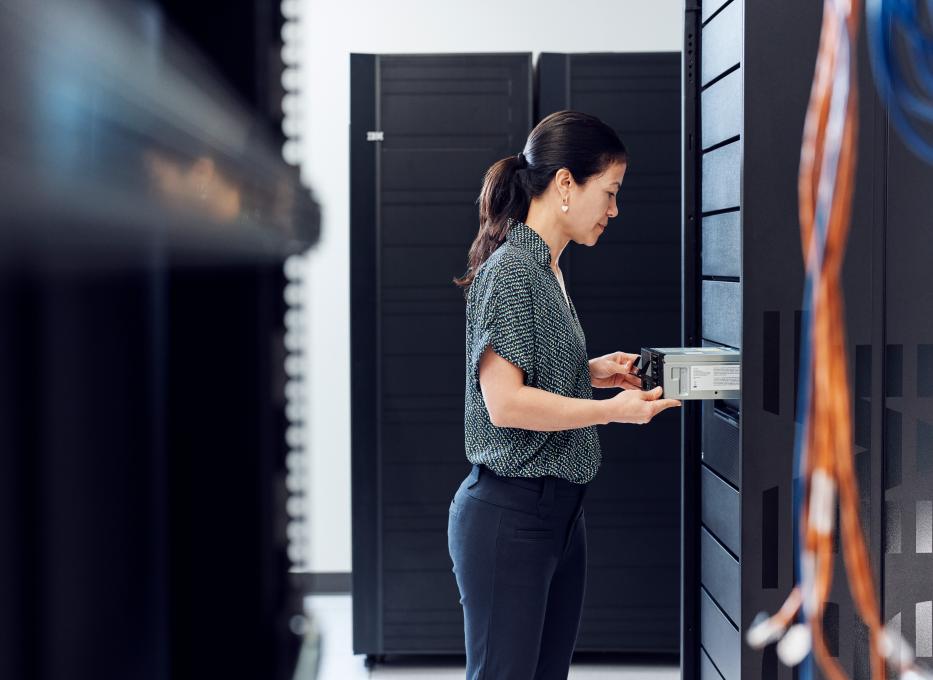
Architecture and Form Factor
The S1112 is built around a single Power11 entry Single-Chip Module (eSCM), available in 4-core or 10-core configurations, giving IT teams two officially supported chassis: a 19-inch, 2U rack drawer (machine type 9242-21B) or a deskside tower (9242-21T). Both share the same underlying architecture, so the choice comes down to where the system will physically sit – a standard server room or comms cabinet versus an office, retail back-room, or similar space without formal rack infrastructure.
The system supports IBM AIX, IBM i, and Linux, which means a single S1112 can genuinely consolidate mixed workloads onto one box rather than requiring separate hardware per operating system. That consolidation is particularly relevant for organisations replacing several older, single-purpose systems at a branch or regional site with one modern, more efficient platform.
Memory, Storage, and Performance
The S1112 supports next-generation DDR5 DDIMM memory, with a system maximum of 512 GB across four DDIMMs running at 4000/4800 MHz – a meaningful bandwidth and reliability improvement over the DDR4-based systems it typically replaces. Local storage comes from four internal NVMe U.2 bays, providing up to 12.8 TB within the system unit itself, which keeps latency-sensitive workloads such as transactional applications and AI inferencing close to the data rather than reliant on external storage.
On the published benchmark figures, the 4-core configuration delivers 117,300 CPW and an AIX SMT8 rPerf of 148.8, while the 10-core configuration delivers 116,500 CPW and an rPerf of 298.7 – illustrating that IBM i throughput scales differently to AIX throughput as core count increases, which is worth factoring into sizing conversations depending on which operating system carries the primary workload.
I/O expansion is more modest than IBM’s scale-out range, as would be expected of an entry system: four PCIe Gen4 slots are built into the system unit (two x8, two x16), with the option to add up to two external PCIe Gen4 I/O drawers for organisations that need additional network, fibre channel, or storage adapters. Anyone consolidating from a system with a large number of existing adapters should map current slot usage against this figure before committing to a like-for-like replacement.
Security and Reliability
Every S1112 ships with embedded quantum-safe cryptography covering secure boot and firmware integrity validation, extending Power’s enterprise security model down to its smallest system. This matters increasingly for organisations working through data protection and regulatory requirements that anticipate future cryptographic threats, not just current ones.
On the reliability side, the S1112 includes Chipkill memory protection, Dynamic Processor Deallocation, Processor Instruction Retry, Active Memory Mirroring, and redundant hot-plug power and cooling. Combined with automated error log collection and AI-assisted troubleshooting, these features are designed to reduce the risk and impact of unplanned downtime in locations that may not have on-site IT staff to respond to a hardware fault – a common characteristic of the branch and remote deployments this system targets.
AI and Edge Workloads
Built-in on-chip Matrix Math Acceleration (MMA) allows the S1112 to run AI inferencing workloads locally, without sending data back to a central data centre or cloud environment for processing. IBM points to use cases such as real-time analytics, computer vision for quality inspection, and intelligent automation at branch or remote sites – scenarios where reducing latency and keeping data local both matter, whether for performance or for governance reasons.
IBM i Workload Flexibility
For organisations running IBM i, the S1112 operates within the P05 software tier, supporting up to 4 IBM i cores and 64 GB of memory for core business applications. Any remaining processor cores and memory on a 10-core configuration can be allocated to AIX or Linux workloads running alongside IBM i on the same physical system, without affecting IBM i’s software tier eligibility. This gives organisations a way to run traditional IBM i applications and newer Linux-based analytics or automation workloads side by side, rather than provisioning separate hardware for each.
Where the S1112 Fits
The S1112 is best suited to single-socket deployments: branch and remote office upgrades, retail and manufacturing edge locations, and IBM i P05-tier workloads that don’t require multi-socket scale. Organisations running data-intensive, multi-socket workloads – large databases, SAP HANA, container platforms, or consolidation from multiple older Power7/Power8 systems – are generally better served by IBM’s scale-out range, such as the Power S1124 and L1124, which offer significantly greater core count, memory, and I/O headroom.
Covenco’s Power specialists can review your current workload profile, software tier, and licensing position to confirm whether the S1112, a scale-out system, or a mixed deployment is the right fit before you commit to a configuration.