


Article
IBM FlashSystem 5600 vs 5300: What Has Actually Changed?
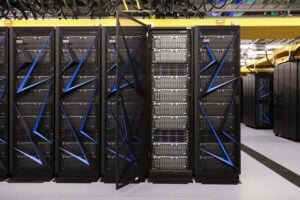

The IBM FlashSystem 5600 is not a spec refresh. It is a hardware generation change, and the difference is visible the moment you pull the unit out of the box.
Covenco Sales Director Steve Hollingsworth and Senior Technical Architect Chris Slater unboxed a live FlashSystem 5600 unit on camera, walking through every major change from the 5300 architecture that preceded it. Between them, they bring over 50 years of enterprise storage experience. This is what they found.
Skip straight to the hardware walkthrough? Watch the full unboxing and technical breakdown here.
What Is the IBM FlashSystem 5600?
The FlashSystem 5600 is IBM’s latest entry-level NVMe all-flash array, designed for mixed enterprise workloads including virtualisation, databases, container platforms, and hybrid cloud environments. It sits in the mid-range of the updated IBM FlashSystem portfolio, replacing the 5300 as part of a wider 2026 refresh that also introduced the 7600 and 9600 models.
In a single 1U enclosure, the 5600 supports up to 12 NVMe drives, delivers up to 2.6 million IOPS and 30 GB/s bandwidth, and scales to 2.5 PBe effective capacity per system, extending to 77 PBe with expansion. For a single rack unit, those numbers are significant.
IBM FlashSystem 5600 vs 5300: The Key Differences
The jump from the 5300 to the 5600 is primarily a drive architecture change. Understanding it requires understanding FlashCore Modules.
FlashCore Module 5 (FCM5) vs FCM4
IBM designs and manufactures its own flash drives, called FlashCore Modules. This is one of the few areas in enterprise storage where a vendor controls the full stack from NAND to array software, and it gives IBM capabilities that competitors using commodity NVMe drives cannot replicate.
The 5300 used FCM4 drives, available in capacities from 4.8 to 38.4 TB. The 5600 moves to FCM5, available in 6.6, 13.2, 26.4, 52.8, and 105.6 TB. That last figure, 105 TB per drive, is the highest available in the industry for enterprise workloads.
IBM achieves this by using QLC NAND with proprietary firmware that makes it perform at TLC endurance levels. For context: standard QLC NAND has lower write endurance than TLC and is typically restricted to read-heavy workloads. IBM’s approach removes that constraint, making the 5600 suitable for write-intensive mixed workloads that would have required TLC-based drives from other vendors.
Ransomware Detection at the I/O Level
Most storage systems detect ransomware at the file system or network layer. IBM has moved that detection one level lower, directly into the flash module hardware itself.
FCM5 monitors every I/O operation using machine learning models embedded in the drive. If encryption patterns consistent with ransomware are detected, the system alerts in under 60 seconds, with less than 1% false positives. This is not a software layer running on the array controllers. It runs inside the FCM5 module, which means there is no performance impact on host workloads and no dependency on network visibility.
The practical implication: you can detect an active ransomware incident before it has encrypted enough data to cause significant damage. That is a meaningful change from detection at the backup or network level, where the window is typically much wider.
Quantum-Safe Encryption
FCM5 includes quantum-safe encryption baked directly into the drive hardware. Data is encrypted at rest using algorithms designed to remain secure against quantum computing attacks. This is not an add-on or a software feature. It is part of the drive itself and operates with no measurable performance impact.
For organisations in regulated sectors, defence supply chains, or those planning infrastructure that needs to remain secure over the next decade, this is a relevant consideration.
Memory Configuration and Workload Support
The 5600 ships with higher default memory configurations than the 5300. This directly affects which features can run simultaneously. Organisations running heavy snapshot schedules, active replication, high VM density, or container platforms with significant metadata overhead will notice the difference in practice.
IBM claims up to 40% greater data efficiency across the new FlashSystem generation compared to the previous one.
FlashSystem.ai
New to the 5600 generation is FlashSystem.ai, an agentic AI layer that acts as an autonomous co-administrator across the storage estate. It monitors performance, predicts capacity requirements, flags anomalies, and can take corrective action without manual intervention. Think of it as moving storage management from a reactive posture to a predictive one.
Who Is the IBM FlashSystem 5600 For?
The 5600 is positioned for organisations that need enterprise-grade performance and security in a compact, energy-efficient footprint. It suits:
- Edge deployments and remote offices that need full enterprise capability without a large physical footprint
- Virtualisation-heavy environments with high VM density and active replication
- Organisations in regulated industries where data sovereignty, encryption, and auditability are non-negotiable
- IT teams evaluating storage refresh cycles, particularly those currently running FlashSystem 5300 or older arrays
- Businesses that have experienced or are concerned about ransomware, where detection speed directly affects recovery scope
Watch the Full Unboxing and Technical Breakdown
Covenco’s Steve Hollingsworth and Chris Slater walk through a live FlashSystem 5600 unit, covering the hardware in detail, comparing it to the 5300, and explaining the FCM5 architecture in plain terms. No slides. No script. Just the unit on the table and 50 years of storage knowledge between them.
Watch the IBM FlashSystem 5600 unboxing and technical breakdown: Watch the full unboxing and technical breakdown here.
IBM FlashSystem 5600 Specifications at a Glance
Form factor: 1U rack-mounted NVMe
Drive slots: 12 NVMe FCM5 slots
Drive capacities: 6.6 / 13.2 / 26.4 / 52.8 / 105.6 TB per drive
Maximum IOPS: 2.6 million
Maximum bandwidth: 30 GB/s
Response time: under 50 microseconds
Effective capacity (per system): up to 2.5 PBe
Effective capacity (with expansion): up to 77 PBe
Processors: dual 12-core Intel Xeon
Cache: 512 GB
Connectivity: 64Gb Fibre Channel or 100Gb Ethernet (NVMe/TCP)
Security: quantum-safe encryption, ransomware detection, Safeguarded Copy, immutable snapshots
Management: IBM Storage Virtualize, Storage Insights Pro, FlashSystem.ai
Frequently Asked Questions
What replaced the IBM FlashSystem 5300?
The IBM FlashSystem 5600 replaces the 5300 as part of IBM’s 2026 FlashSystem refresh. The 7600 replaced the 7300, and the 9600 replaced the 9500.
What is FCM5?
FCM5 stands for FlashCore Module 5. It is IBM’s fifth-generation proprietary NVMe flash drive, manufactured and designed by IBM. FCM5 includes embedded AI for ransomware detection, quantum-safe encryption, and QLC NAND engineered to TLC performance levels. It is exclusive to the new FlashSystem 5600, 7600, and 9600.
How fast does the FlashSystem 5600 detect ransomware?
The FlashSystem 5600 detects ransomware at the flash drive level in under 60 seconds, with less than 1% false positives. Detection happens inside the FCM5 module, directly monitoring I/O patterns rather than relying on file system or network-level inspection.
How does the 5600 compare to the 5300 in terms of capacity?
The 5300 used FCM4 drives topping out at 38.4 TB per drive. The 5600 uses FCM5 drives available up to 105.6 TB per drive, representing a roughly threefold increase in maximum drive capacity within the same 1U form factor.
Is the FlashSystem 5600 suitable for edge deployments?
Yes. Its 1U form factor, energy-efficient design, and full enterprise feature set make it well-suited to edge deployments and remote offices where rack space is limited but performance and security requirements remain high.
Can I talk to Covenco about the FlashSystem 5600?
Yes. Covenco is an IBM storage specialist based in Oxfordshire. Contact the team via email: enquiries@covenco.com.
Still have questions about the FlashSystem 5600?
Watch the unboxing from Covenco’s technical team or contact us directly to discuss your storage requirements.