


VIDEO
Enterprise Storage in 2026: Cyber Resilience, Commercial Reality, and the Conversation UK IT Leaders Should Be Having
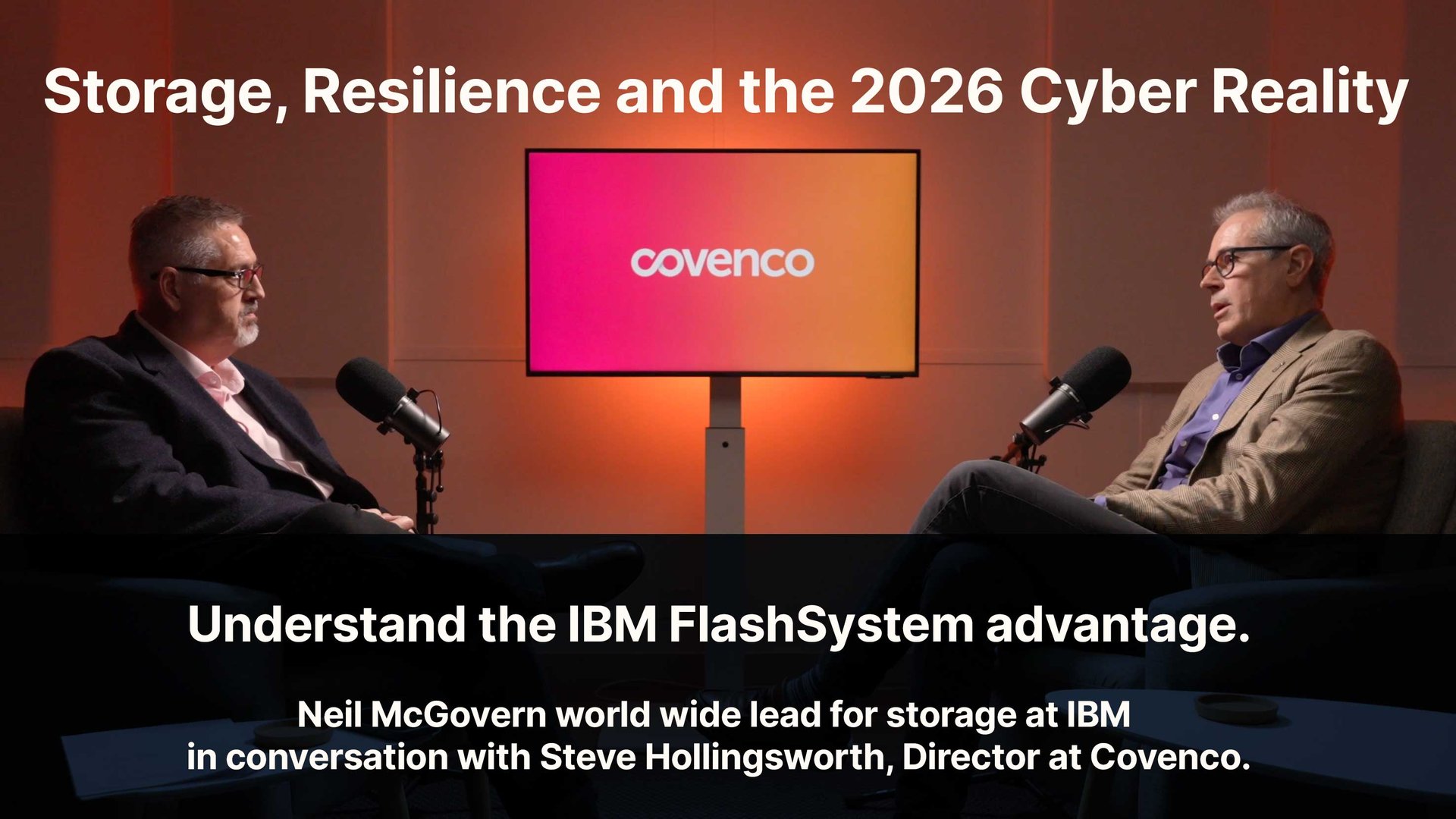
A 12-minute conversation with IBM’s Neil McGovern and Covenco’s Steve Hollingsworth on what has actually changed – and why the FlashSystem story is not what most customers expect.
For anyone reviewing their data storage strategy for 2027, three data points from the past twelve months are worth understanding:
- 323 UK businesses reported ransomware attacks to Report Fraud between April 2025 and March 2026 (City of London Police).
- The average financial loss was £270,000. Average downtime now exceeds 21 days.
- 94% of ransomware attacks specifically target the backups (Cyber Monitoring Centre).
Layer on the Cyber Security and Resilience Bill (UKCSRB), currently progressing through the House of Lords, which extends mandatory cyber duties to managed service providers and digital supply chains, and the storage decision is no longer a purely operational one. Boards, insurers and regulators are all watching.
Recent public incidents in the UK drive the point home… Marks & Spencer took 46 days to restore online shopping following its 2025 attack, with reported losses in the region of £400 million. Jaguar Land Rover was breached in October 2025. The Co-op and Synnovis (approximately £32.7 million in recovery costs) followed. Each of these was a large, well-resourced organisation. Each was left with a recovery timeline measured in weeks, not hours.
Why Traditional Disaster Recovery Is No Longer Enough
Disaster recovery, in its classical form, was designed for one-in-a-million events. Fire, flood, terrorist attack, extended power outage. The playbook assumes a threat from outside your environment acting on a defined asset.
Ransomware breaks the model. It gets inside the environment, moves laterally, and specifically targets the backups a DR strategy relies upon. As Neil McGovern puts it in the conversation, “if they take out the backups, it leaves you with no choices, only to pay.”
Modern cyber resilience is a different discipline. It assumes attackers will get in and asks three different questions: how quickly can we detect an active threat, how quickly can we recover to a known good state, and how confidently can we guarantee that the recovery point is clean?
The answer to all three, increasingly, sits at the storage layer.
What Actually Makes IBM FlashSystem Different
Most enterprise storage arrays run their ransomware detection on the storage controller. This creates an engineering constraint. Sampling every piece of data can grind the controller to a halt, so instead, vendors typically sample between 1% and 5% of I/O. The rest is assumed.
IBM took a very different architectural decision fifteen years ago. Every drive in a FlashSystem array is a proprietary Flash Core Module – not a commodity SSD. Every FCM contains its own AMD-designed accelerator chip – which handles four things in-line, at full drive speed:
- Real-time data reduction and de-duplication
- Quantum-safe encryption at rest
- Compression that preserves performance as capacity scales
- Anomaly detection on 100% of I/O, with a sub-60-second detection guarantee
Coupled with Safeguarded Copy – immutable snapshots taken automatically the moment an anomaly is detected, held on the production array itself for sub-60-second recovery – the IBM FlashSystem architecture answers the cyber resilience question at the layer where the data actually lives.
The technical detail matters because it is the reason IBM can offer guarantees others can’t. When 100% of I/O is being examined by dedicated silicon on every drive, sub-60-second detection is an engineering outcome, not a marketing promise. For a full walkthrough of the architecture, explore our IBM FlashSystem pages.
The Pricing Story Most Customers Don’t Expect
Ask a UK IT leader to rank the most price-competitive vendors in enterprise all-flash storage and IBM rarely appears near the top of the list. That perception, as Neil McGovern acknowledges directly, is IBM’s biggest single challenge with the platform. He calls it “The best kept secret in enterprise storage”.
According to IDC pricing data published by Blocks & Files, the IBM FlashSystem 5300 base configuration currently prices at $67,000. Equivalent configurations from Dell PowerStore 500T, Everpure (formerly Pure Storage) FlashArray//X20, and HPE Alletra 6010 price between 2.4x and 2.9x higher – between $161,000 and $194,000 for comparable capability.
That is before the total cost of ownership case. Features that other vendors sell as licensed extras – anomaly detection, Safeguarded Copy, encryption, orchestration – are included in the FlashSystem base software. Higher storage density reduces data centre footprint. Better power and cooling economics reduce operating costs across a five-year deployment. IBM Storage Assurance keeps hardware and software current without disruptive re-purchases.
If you have not seen recent IBM pricing for FlashSystem, our price match offer page exists precisely because the pricing surprise is where most conversations start. We will put a like-for-like comparison against your current vendor in front of you within 48 hours.
Why a Certified Gold IBM Partner Matters
Only Covenco as an IBM Gold Certified Business Partner can deliver certified integration, audited technical implementation, and the depth of specialism that comes from over 20 years years of working with the platform across UK enterprise environments.
Covenco has been an IBM Business Partner since 2000. We are IBM Gold accredited, and ISO 27001 certified. Founded in 1989, we have delivered dozens of FlashSystem projects across UK organisations in the 250 to 5,000 seat range – from initial migration through to FlashSystem Grid federated deployments. We have watched the platform evolve from the original StoreWize V7000 through to today’s incredibly smart Flash Core Modules.
For anyone assessing their storage strategy for the next 12 months, the partner conversation is inseparable from the technology. The value is in combining the certified IBM solution with our broader capabilities – automation, migration, backup, disaster recovery, refurbished infrastructure, and managed services – that turn a hardware purchase into a delivered and functional outcome.
Watch the Full Conversation
The 12-minute conversation embedded above features Neil McGovern (IBM’s Worldwide Lead for Storage Sales) and our own Steve Hollingsworth. It covers the architecture, the commercial case, and what UK businesses should be asking before their next storage strategy decision.
- Request a no-obligation price comparison for your environment
- Or call the Covenco team directly on 01753 732 000